Pigtails and Extensions
(Last edited 5/14/2026)
An extension is simply an extra segment of cable that lengthens an existing cable. A pigtail is a single cable fitted with more than one connector. The reason the final stub is called a “pigtail” is because of its short, flexible nature; much like a pig’s tail. Yes, the name is a bit silly.
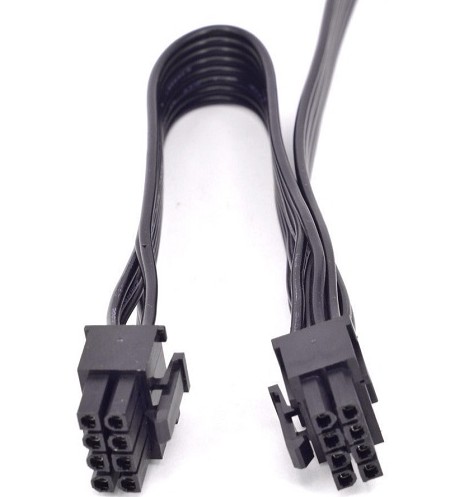
A pigtail cable is a cable with two connectors daisy chained on the load end of the PSU
The two have similar electrical pitfalls on the surface,yet many users treat them as completely different creatures. I’ve often seen the same online influencer trash pigtails in one video, then gush about their sponsored extensions in the next. Ironically, it’s often the extensions that can be more problematic.
Let’s start with extensions. Their first weak point and common failure mode is the additional connector needed to attach the extension onto your primary cable. The introduction of the additional connection creates the same problem that I described with the advent of modular interfaces. When they are properly interfaced, the added resistance is minimal, but one has to be concerned about the connectors being fully connected and that terminals do not get damaged.
The more serious drawback of extensions, though, is voltage drop. Longer cable equals higher resistance, and that eats into the voltage at the far end. Keyboard warriors will point out that a 60 cm cable versus a 120 cm cable shows negligible resistance when measured at room temperature with no current flowing… and they’re not wrong. Without a load, the cable can be 70 meters long and still have less than an Ohm of resistance because there is no current to generate heat. When current encounters resistance as it passes through wire, it creates heat. This heat creates resistance, and a cycle is created. Fortunately, unlike thermal runaway, this cycle is linear.
Pigtails can be well made, or poorly made. I’m not talking about poor quality control. I’m talking about poor design choices like using an 18 AWG wire from the PSU to the first connector instead of 16 gauge.
One misconception about pigtails is that because the 6+2-pin PCIe connector is rated at 150W, a second 150W connector shouldn’t be tapped off of it. In practice, a pigtail’s two connectors are simply crimped onto the same conductors, so the rating of the first plug’s terminals doesn’t limit the second. The only limitation is the wire itself and whatever the connector back at the power supply is rated at.
Crunch the numbers, and you’ll see that with uniform wire gauge, a dual-connector pigtail has the same total resistance as a single cable twice its length, while carrying only half the current of the former. The upside is obvious: the pigtail gives you two power connectors, whereas a lone extension leaves you with just one.
From a manufacturer’s standpoint, just make sure your engineers do the proper math to determine the correct materials are used and do so with appropriate margin.