The Move From 80MM to 120MM and Larger Fans
(Last edited 5/14/2026)
In the early days of computer power supplies, cooling was straightforward. You'd find an 80mm fan at the back, front, or sometimes both positions. Air traveled in a simple path: entering the front, flowing directly across heatsinks, and exiting the back. No complicated airflow patterns, no redirection baffles, no elaborate heatsink designs. The drawback? Those 80mm fans had to spin rapidly to move sufficient air, creating a high-pitched whine many users found irritating.
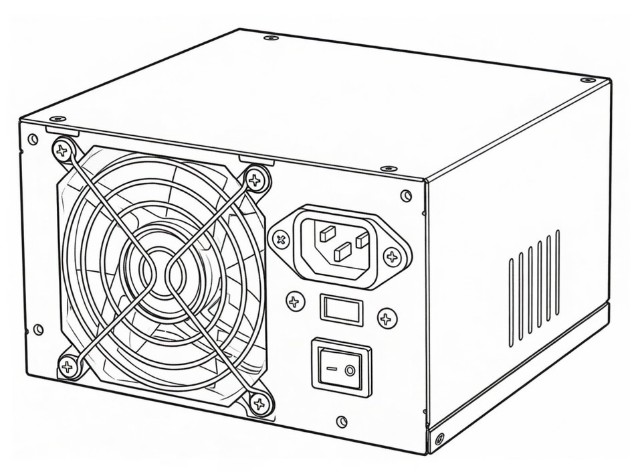
A line drawing of a traditional power supply unit with an 80mm exhaust fan.
Around 2003, rather than addressing the root problem of inefficient power supplies generating excessive heat, and therefore requiring very loud fans to remove said heat, many manufacturers simply relocated the fan to the top and increased its size from 80mm to 120mm or larger. These PSUs still lacked power factor correction (except in Europe, where they used passive PFC and gimped bridge rectifiers), still employed double forward conversion, used passive rectification with Schottky diodes, and remained group regulated. They generated tremendous heat, but instead of engineering cooler components, companies just installed larger fans.
Although LLC Resonant Conversion technology existed since 19886, it wasn't until stricter energy regulations and consumer demand for quieter systems in the 2000s that manufacturers adopted resonant designs. Specialized LLC controller ICs became widely available, making implementation practical and affordable.
Top-mounted 120mm or larger fans create another problem: they severely restrict the height of internal components. These fans occupy just over 25mm of the PSU's vertical clearance, forcing manufacturers to reduce heatsink, capacitor, and other component heights by approximately 30% compared to designs using front or rear-mounted 80mm fans. This dimensional constraint directly impacts thermal performance and component selection.
While a larger fan will always be quieter than a smaller one while both are running at the same RPM, I have to wonder how much quieter a PSU would be if we were to go back to a traditional 80mm fan that barely has to rotate at all.