Capacitor Shelf Life
(Last edited 5/14/2026)
Since we’ve been talking about capacitors for the bulk of the beginning of this e-book, we might as well discuss capacitor life and the impact a stored capacitor, or power supply, has. The effects of storing discharged capacitors are often overlooked. This doesn't just apply to a collection of new capacitors on a shelf but also to those already installed within a power supply.
Even under ideal storage conditions, temperatures between 5° and 35°C and relative humidity below 75%, a PSU might only be fine for up to three years. However, if it has been kept in a place like a warehouse or garage during summer months, the situation might be completely different.

Might not be the best place to store your power supply.
So, what happens as capacitors age? High humidity can lead to corrosion. And at elevated temperatures, the leakage current and equivalent series resistance (ESR) increase, while the capacitance and rated voltage decrease. These changes occur due to a chemical reaction between the oxide layer and the electrolyte. Applying the rated voltage to a long-stored capacitor could result in the dielectric breaking down and the relief vent eventually popping open.
Can Capacitors Really Be Reformed?
For those technically inclined to do so, a capacitor can be “reformed”. This process is done with the capacitor removed from the circuit. I’d also like to add that this process should only be attempted by experienced individuals with proper safety precautions.
Reforming involves gradually applying power to the aged capacitor. You connect the capacitor to a resistor placed between its negative leg and the negative terminal of a bench power supply. Start with a voltage lower than the capacitor's rating. Depending on the rated voltage of the cap, I would suggest 1/3rd to 1/5th the rated voltage. Let it sit for an hour at this lower voltage, then increase the voltage and let it sit for another hour. Repeat this process until the capacitor reaches its rated voltage. Leave it overnight at this level. The next morning, check the capacitor with an ESR/LSR (Equivalent Series Resistance / Leakage Series Resistance) meter to ensure the equivalent series resistance and leakage current meet specifications. If everything is in order, discharge the capacitor and reinstall it into the circuit.
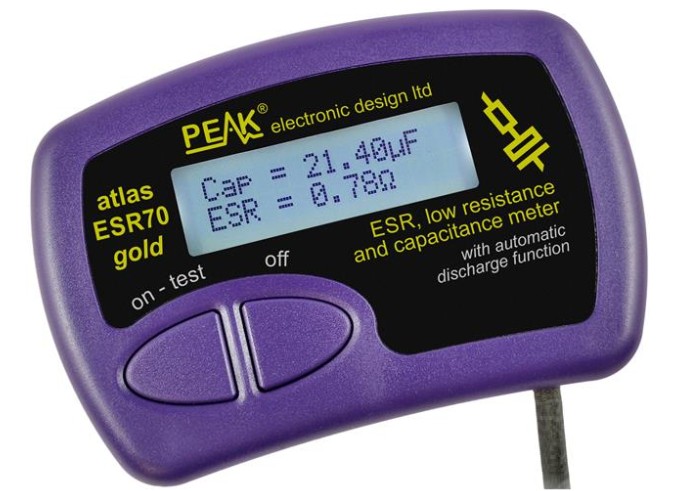
PEAK makes an affordable ESR/LSR meter. Even if you don’t plan to reform, it’s a good tool to have around to at least check the condition of old capacitors.
Clearly, this process requires several tools. While many of my peers might have a bench power supply and a drawer full of random resistors, not everyone has an ESR/LSR meter handy. Furthermore, reforming electrolytic capacitors involves applying voltage to components that can store and release significant energy. Therefore, this process carries risks including explosion, fire, and electric shock. Even with precautions, reforming may not restore a degraded capacitor to safe, reliable operation. In my view, if you're going to the trouble of removing a capacitor from a circuit to reform it, you might as well replace the capacitors with new ones.