What is Ripple, Why is it Bad… and How Did it Change my Career Path
(Last edited 5/14/2026)
I chose to begin with capacitors because they’re the one component most people recognize; and because my own path into power supplies started with them, leading me from building and repairing PCs to eventually reviewing, marketing and eventually designing PSUs.
I originally thought about calling this e-book “Box of Caps.” Seriously. “e-book of Caps” wouldn’t reflect the same “inside joke”. You see, among engineers, that phrase sums up how it seems most laypeople blame every PSU failure. Blamed on a popped capacitor. See smoke? Assume magic smoke escaped. Spot a spark? Conclude that a cap exploded. Notice what is actually RTV on the PCB? Swear it’s a capacitor leaking electrolytic fluid. The true workings of a power supply remain a mystery to most, and the ever-present warning about electrocution if you pry one open only adds to the mystique.
Of course, a power supply is far more than a handful of capacitors, and this e-book will explain that. While opening a PSU seldom proves fatal, you still must respect the large primary-side caps. They can pack a nasty shock if you’re careless. It’s like nodding off on train tracks: the odds of fatality are small, but not zero. So why take the chance?
Fortunately, discharging capacitors is simple. Handheld PSU testers like the Kingwin Power Supply Tester that sells for under $20 on Amazon4 have a ballast resistor that can be used to drain the PSU’s caps. In fact, most PSUs these days include bleed resistors that safely drain stored charge over time, and since around 2020, IEC safety standards have tightened discharge requirements, effectively mandating internal discharge paths in compliant PSU designs to reduce shock risk even further.

Just let this little resistor inside the cheap PSU tester drain your capacitors over time.
My journey began when I saw swollen caps on motherboards that hadn’t been hit by the infamous capacitor plague. It took two friends from Antec to explain what was really going on before the connection clicked. But before I dive into that tale, let’s cover AC ripple current, usually just called “ripple”, and why keeping it in check is crucial.
Whenever you convert AC to DC, some of that AC rides along in the output. In a switch-mode power supply (a term we’ll define later), incoming AC is rectified to DC, chopped back to AC, then rectified again into DC; generating high-frequency noise and harmonics in the process.

This is a screenshot from an oscilloscope of AC ripple on a DC output.
Excessive ripple heats capacitors, evaporating their electrolyte and risking catastrophic failure. Caps rated for 105°C tolerate ripple longer than the standard 85°C parts, which is why quality motherboards use them. Polymer aluminum “solid caps” are even more robust, boasting high-frequency ripple specs and 105 °C (or higher) temperature ratings.
On the PSU’s output side, smaller capacitors filter out as much ripple as possible. But upsizing capacitance to chase lower ripple raises inrush current, since all those caps must charge fully before the supply reaches its rated voltage. Output voltage regulation can be affected when power excursions, or "transients", as some people call them, partially drain the capacitors, requiring them to recharge to maintain proper output voltage. This also stresses the switching components. So it’s best to find the right balance of capacitance and acceptable filtering.
When the cheap power supplies sold by the computer store down the road started killing off our motherboards, my Antec contacts showed me how to use a load tester and an oscilloscope to measure ripple under simulated loads. Their Antec PSU delivered only about 50 mV of ripple at full load (that was really good at the time), but the budget PSU from the other store couldn’t handle even half its rated load without the ripple spiking to roughly 250mV; well above the ATX specification.
That experience led me to invest in a SunMoon SM-268 load tester, an analog Tektronix oscilloscope, a half-meter-tall variac, and an IDRC power meter. And that was the real beginning of my PSU-reviewing days and my mission to dispel the myth that a power supply is “just a box of capacitors.”
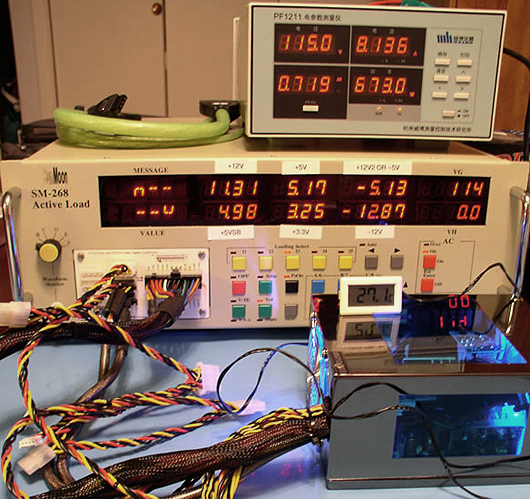
My old SM-268 setup from around 2005.