Understanding Power Factor
(Last edited 5/14/2026)
Eventually, we’re going to discuss correcting the power factor of our power supply. Of course, technically, we don’t have to correct it. You know those power supplies that have the little red 115/230 switch on the back? These lack any form of power factor correction (PFC). But these types of power supplies are pretty rare these days. Especially since the EU had effectively banned the use of non-power factor corrected devices back in 2001.
Power factor is a crucial metric in electrical systems, serving as an indicator of how proficiently electrical power is being transformed into productive work output. Unlike the straightforward efficiency percentage calculation of output divided by input, power factor specifically reveals how effectively the current drawn from the source is being utilized to accomplish genuine work.
For us to calculate power factor, we need to understand three terms used in the calculation. Apparent power, real power and reactive power.
Apparent power represents the total power supplied to the circuit and is measured in “VA” (Volt Amps).
Real Power is measured in Watts (“W”) and represents the actual AC power that performs tangible work, such as powering a motor or illuminating a bulb. In the context of this e-book, it refers to the power that is ultimately converted into DC.
Reactive power is the elusive energy that fluctuates back and forth between the source and reactive components, such as the inductors and capacitors in the power supply, without performing any useful work. Reactive power is measured in “VAR” (Volt Amps Reactive).
By taking the "real power" and dividing it by the "apparent power", one obtains the power factor.

Reactive power is considered problematic because it increases the overall current flowing through the power supply. Although it doesn't supply useful energy to the computer that the PSU is powering, it still adds to the current that power lines, transformers, and generators need to manage. This additional current results in more resistive losses on the power grid, generating heat and wasting energy.
Since electrical equipment is rated by apparent power (VA) rather than just real power, a system with high reactive power is effectively consuming part of its capacity merely to support the reactive load. This diminishes the amount of real, productive power the system can deliver without requiring larger transformers, generators, or wires. It can also lead to voltage drops over long distances, making it challenging to maintain stable voltage at the load, causing voltage fluctuations, and lowering power quality, potentially damaging sensitive electronic equipment.
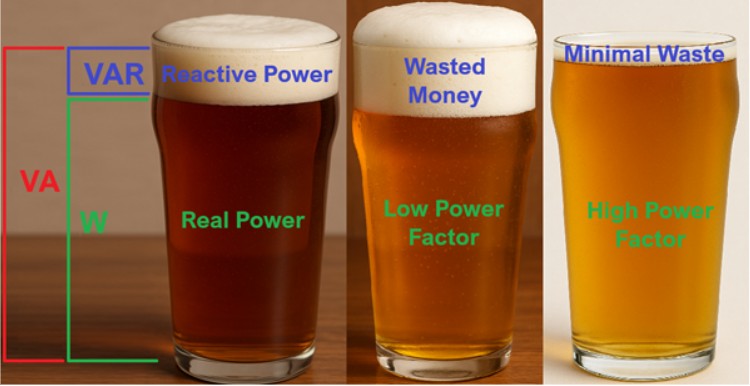
The “beer analogy” is a popular means of illustrating reactive power vs. real power.