The Capacitor Plague
(Last edited 5/14/2026)
In the early 2000s, PC builders and repair technicians began spotting an alarming number of motherboards whose electrolytic capacitors were bulging, leaking, or even bursting. This problem quickly earned the name “capacitor plague.”
Rumor had it that a team of researchers who once worked for Japan’s Rubycon Corporation defected to Taiwan’s Luminous Town Electronics (LTEC). LTEC was once the Taiwan sales agent for Rubycon but was moving into manufacturing their own capacitors under their own name. At LTEC, these researchers allegedly reverse-engineered Rubycon’s P-50 water-based electrolyte and used it in their own aluminum electrolytic capacitors.
When a portion of those scientists departed LTEC they left carrying what turned out to be an incomplete version of the P-50 formula. They ended up selling it either directly to other Taiwanese capacitor makers or to a third-party electrolyte supplier. Missing critical additives known as depolarizers, the flawed mix generated hydrogen gas inside the capacitors, causing them to swell and rupture. Its elevated pH also corroded the aluminum plates, diminishing the caps’ ability to hold charge. This tainted electrolyte turned up in capacitors from numerous brands, including Jun Fu, Choyo, Chhsi, G-Luxon, Evercon, Sacon, Lelon, Licon, Tayeh, CapXon, Jackcon, JPCON, and Rulycon (not to be confused with the original Rubycon).
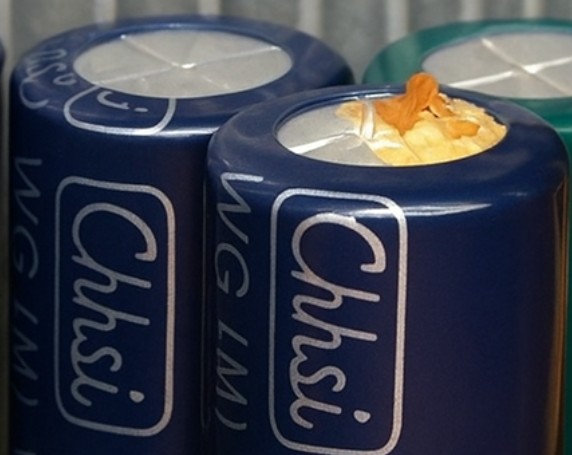
A venting Chhsi brand capacitor. These were known to have the “stolen electrolyte formula” which caused premature failures.
IBM was the first major PC maker to admit it had used these capacitors, though it downplayed the issue by claiming only about a 1% failure rate. In 2005, motherboard manufacturer Abit acknowledged it had employed “plagued caps” and announced a switch to Japanese brands. Unfortunately for Abit, this “admission of guilt” prompted a class-action lawsuit alleging deceptive practices.
One of the more notorious capacitor failures involved Antec power supplies outfitted with Fuhjyyu capacitors. Experts at the time insisted those caps hadn’t used the stolen P-50 recipe, attributing failures instead to poor airflow or circuit designs that required different capacitance values. From my own experience, that explanation holds up: I’ve seen brand-new, unopened PSUs develop leaky caps simply from sitting in a hot, humid warehouse. Proof that even top-quality electrolytics can degrade under harsh storage conditions. Moreover, every power supply undergoes full functional testing, hi-pot testing, and burn-in in high-temperature chambers at 75 percent load for four to eight hours before it ever leaves the factory. This is a regimen that can usually expose any latent design or component flaws.

A number of leaking Fuhjyyu capacitors inside an Antec True Power power supply.
I’ve also run into design-related capacitor failures firsthand. More than a decade ago, a project I worked on specified a SamXon bulk capacitor. A flaw in the power-factor-circuit caused an inductor to saturate, overstressing the bulk cap until it gave out and popped. End users instantly blamed the capacitor; with some even citing the plague. This even though SamXon never used any questionable electrolyte formula, and that this particular failure occurred long after the original plague.
Today, the capacitor plague itself is a thing of the past, but its shadow endures. Mention CapXon, G-Luxon, or Lelon, and you’ll still hear people recoil, convinced they’re dealing with “bad caps” destined to fail because of a flawed electrolyte recipe.