When and where to use soft termination MLCCs
(Last edited 5/14/2026)
MLCC, which stands for Multilayer Ceramic Capacitor, is a widely used surface mount technology (SMT) capacitor found in electronic devices. These passive components store electrical energy and are mainly utilized for decoupling, filtering, bypassing, and timing tasks within circuits.
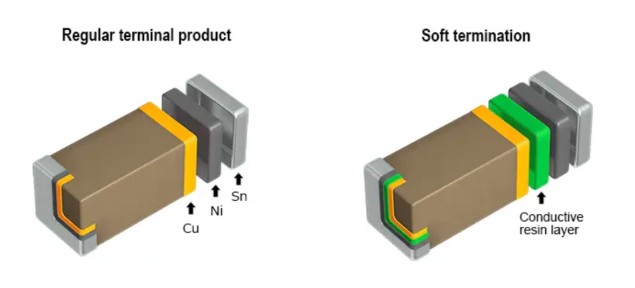
When an MLCC is positioned less than 2mm from the edge of a PCB or less than 3mm from a PCB screw hole, a soft termination MLCC must be employed. Failing to do so can result in these small components either breaking or detaching from the PCB, leading to intermittent connections.
For power supply units (PSUs) with modular PCBs that use MLCCs, it is recommended to exclusively use soft termination MLCCs. This precaution is necessary because the insertion and removal of modular cables can cause the PCB to flex, potentially damaging the MLCC or its connection to the board.
NP0 MLCCs for Current Transformer (CT) and Control Loop Circuits
NP0 refers to a dielectric class with zero temperature coefficient, ensuring stable capacitance across a wide temperature range. Unlike standard MLCCs, NP0 capacitors maintain exceptional temperature stability, with minimal capacitance variation across a broad temperature spectrum. They also show insignificant dielectric losses and almost no voltage coefficient. Naturally, this stability comes at a higher cost.
However, to prevent thermal drift in critical circuits, such as in the use of a CT (timing capacitor for setting converter switching time) and control loops (such as voltage or current feedback paths), it's essential to use NP0 MLCCs. Their predictable behavior ensures the control loop remains stable and performs as designed, even as temperature or voltage changes.
The first diagram below demonstrates how capacitance changes with temperature for Class 1 ceramics. The second diagram shows the temperature dependence of capacitance for an NP0 MLCC, highlighting its tolerance range.