The Importance of Line Filtering
(Last edited 5/14/2026)
Now we’re getting into how a power supply actually works and the line filtering stage is the first critical stage.
One essential purpose of this stage is to prevent high-frequency noise, voltage transients, and power surges present on the AC mains from entering the power supply and damaging sensitive internal circuitry. These disturbances can originate from nearby industrial equipment, lightning-induced surges, or switching transients from other appliances. Equally important, it keeps the switch-mode supply’s own switching noise from feeding back into the public grid and causing electromagnetic interference (EMI) with nearby equipment, since the PSU itself is a source of high-frequency noise due to the rapid switching of currents.
The filter is generally made up of a combination of passive components, such as inductors (or chokes) and capacitors, arranged to attenuate both common mode and differential mode noise.
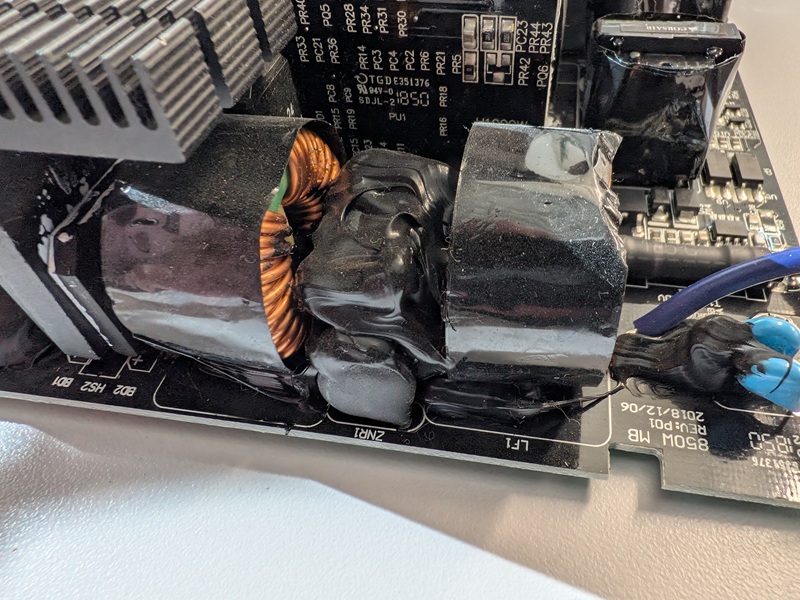
This pair of EMI chokes suppress conducted common‑mode noise going to and from the mains.
Common-mode noise, often created by parasitic capacitances between high-frequency switching nodes (like MOSFETs) and the chassis or earth, is shunted to ground via Y-capacitors, which connect each line conductor (line or neutral) to earth.
However, this earth-shunting creates "leakage current." In ungrounded systems, this current, limited to 3.5mA in properly designed units, seeks an alternative path to ground. If you touch a metal chassis of an ungrounded PC, you become that path, experiencing a mild tingling sensation. While not dangerous, it's why grounded outlets are strongly recommended.
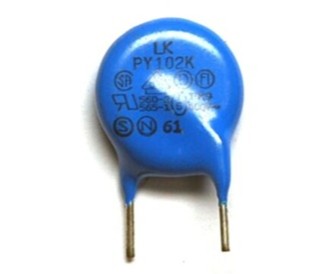
Picture of a Y Capacitor
Medical-grade power supplies feature dramatically reduced leakage current, often measured in microamps rather than milliamps. Engineers can decrease leakage by reducing Y-capacitor capacitance, but this compromises noise filtration efficiency. Solutions exist but add cost and require more internal space within the power supply.
Differential-mode noise, produced by the rapid switching currents flowing between line and neutral, is suppressed by X-capacitors wired directly across them, preventing that noise from appearing at the PSU’s input terminals.
Common-mode chokes, with two windings on a shared magnetic core, present high impedance to common mode currents but little impedance to differential mode currents, effectively blocking common mode noise while allowing power to flow normally.
Surge protection comes from a metal-oxide varistor (MOV). When the mains voltage exceeds its threshold, the MOV’s resistance drops sharply, diverting excess current and clamping the voltage to safe levels.
Finally, to limit damaging inrush currents when the PSU is first energized, one or two NTC (negative-temperature-coefficient) thermistors are placed in series. Cold, they offer high resistance and restrict the initial surge; as they heat under load, their resistance falls and normal current flow resumes. In many designs a relay is added to bypass the thermistor once the supply is up and running, eliminating its series resistance during steady-state operation.