What is an Inductor?
(Last edited 5/14/2026)
We’ve talked about inductors a few times so far. Line filtering, PFC, LLC, secondary rectification, magnetic-amplification… but what IS an inductor. Most of us know an inductor when we see one. It’s a piece of metal with copper wound around it. But what does it do?
When current flows through the copper, which is called the “coil”, it produces a magnetic field. Electric current flowing through a wire always generates a magnetic field. That’s just a basic property of electricity and magnetism. What makes the inductor special is how each loop's magnetic field combines with its neighbors, creating a concentrated field particularly strong at the coil's center. As current fluctuates, this magnetic field responds in kind.
In power supplies, inductors serve multiple critical functions: they filter signals, store and transfer energy, and when configured as transformers, they step down voltages to usable levels.
Understanding Inductor Noise, Also Known as “Coil Whine”
When electricity flows through an inductor, it generates a magnetic field that fluctuates with the current. These fluctuations create tiny push-pull forces between the coils, causing them to vibrate. Usually, these vibrations happen at frequencies too high for human ears to detect. However, when they drop into our audible range is when the infamous "coil whine" becomes noticeable.
Several factors can affect the intensity of coil whine. Power-hungry components like high-end graphics cards draw substantial current, generating stronger magnetic fields and potentially louder vibrations.
In some cases, the core material itself vibrates in response to the magnetic field; a phenomenon called "magnetostriction." Even something seemingly minor, like a single loose wire in the winding, can amplify these vibrations and significantly increase the noise level.
Using RTV to Help Silent Inductors
RTV stands for Room Temperature Vulcanizing and is a type of silicone sealant or adhesive that hardens at room temperature. Applying RTV silicone to the coil can dampen these vibrations and reduce the noise.
It is crucial to use a neutral cure RTV silicone. Standard RTV silicones, like those used for making gaskets, often emit acetic acid during curing, which can corrode electronic components. You’ll realize you’ve gone wrong if you start to smell a vinegar smell coming from your PSU. Neutral cure RTVs, such as oxime or alcohol cure types, are safe for electronics. Look for RTVs that are labeled as “neutral cure” and “safe for electronics.”
When applying RTV, consider the heat dissipation of nearby components. Regular RTV is not very thermally conductive, and applying it to components like diodes and MOSFETs can trap heat, similar to covering them with a blanket. The person applying RTV needs to be well-trained to apply it only where necessary.
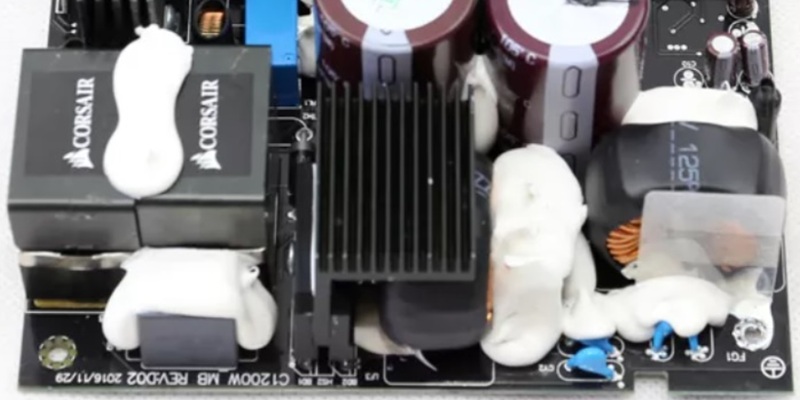
Picture of RTV applied within a PSU
There are materials with excellent thermal conductivity used to encapsulate electronics, known as potting compounds, but they are significantly more expensive. Potting compounds are typically used when components need to be sealed from environmental factors. A process known as “encapsulation”. This process can keep out moisture, reduce vibrations, and even protect against reverse engineering, as removing potting compounds can damage the components on the PCB. I've used potting materials with thermal conductivity as high as 2 or 3W/m-k to create completely passive PSUs by evenly dissipating heat to the PSU housing. However, these compounds are very costly, even in China. So, until they become more affordable, I will continue using typical 1-part neutral cure RTV for my projects.