What Does it Mean When a PSU is “Digital”?
(Last edited 5/14/2026)
Analog PSUs contain a PFC controller IC that drives transistors and regulates bus voltage. They also feature a PWM controller for converting low- frequency DC to high-frequency AC through transistor management. Modern designs often integrate both PFC and PWM functions into a single IC.
On the secondary side of an analog PSU, you have the supervisor IC, which can also be called the housekeeping IC. This IC is responsible for controlling the +5VSB and PS_ON signals and sends the PWR_OK signal to the motherboard. It also monitors for over-voltage, under-voltage, and over-current protection, and in many cases even over-temperature protection.
Digital power supplies take a different approach to control and regulation. Rather than analog components for PWM, PFC, and supervision, they employ microcontrollers or DSPs that handle these functions through software algorithms.
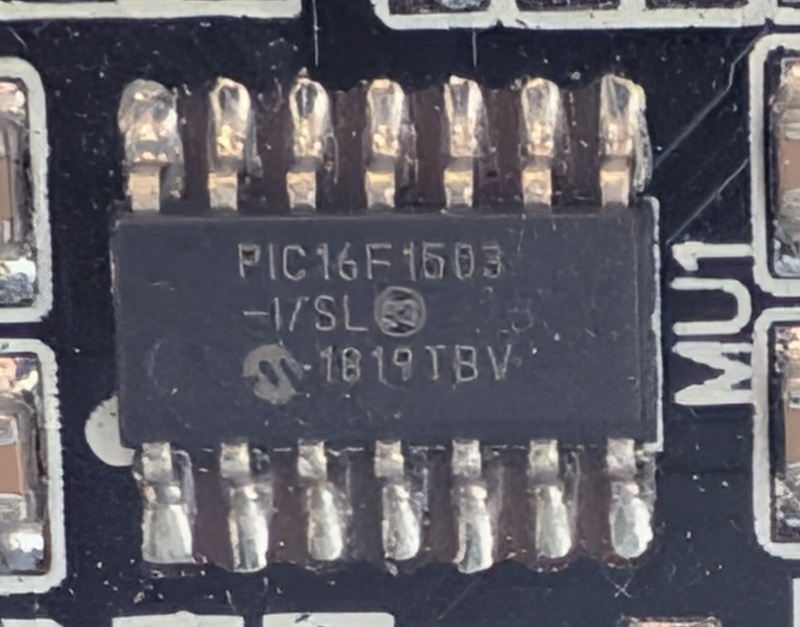
This is the MCU used on the secondary side in Corsair’s HXi Series of PSUs6.
Of course, you will always have the galvanic isolation between primary and secondary sides if you want to maintain safety, so the challenges of communicating between the two are still present. Traditional methods, like using optocouplers, can still be used where the secondary MCU sends a PWM or digital signal through to the primary controller. But for enhanced communication speed, reliability, and energy efficiency between microcontrollers, “digital isolators” offer significant advantages. These components transform digital signals into high-frequency equivalents for transmission across the isolation barrier.