Why are some power supplies “230V Only” and why can’t I find a 2000W PSU that works in my American home?
(Last edited 5/14/2026)
According to Watt's law, achieving the same power output with a lower voltage necessitates a higher current. This increased current is what causes components like MOSFETs and diodes to heat up more. Therefore, in regions with lower mains voltage, more current is needed to achieve the same power, which means the rectification stage of the power supply must be more durable.
A more durable design, however, comes at a higher cost. If you're designing for countries where residential voltages are 240V or higher, there's no need for a rectifier that can handle as much current as one that needs to support 120V. Nevertheless, brownouts can reduce voltage significantly below what is considered normal. Hence, it's crucial to have proper protections in place to prevent the power supply from failing catastrophically if the input current surpasses the bridge rectifier's capacity.
This voltage-current relationship explains why most PC power supplies in the U.S. and other low-voltage markets top out around 1600W.
Consider the electrical standards in Japan (JIS C 8303) and the United States (NEMA 5-15): both limit continuous current to 12A, with peaks allowed up to 15A. PC power supplies rarely reach continuous maximum loads during normal operation—such sustained power draws typically occur only during synthetic testing scenarios like benchmarking or when using Automated Test Equipment. This practical usage pattern allows us to reasonably claim 15A support while maintaining operational safety.
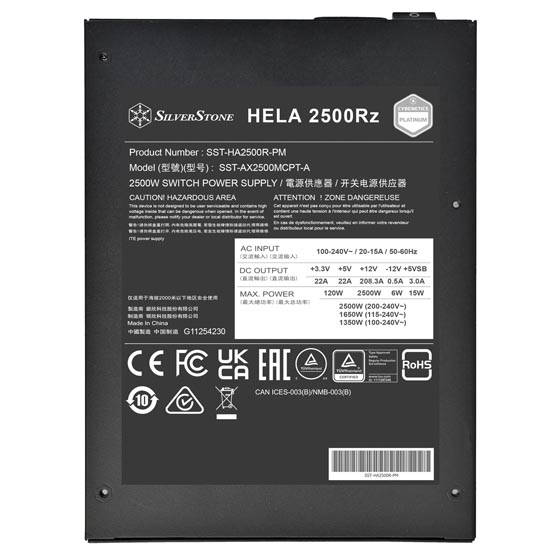
While you can buy this 2500W power supply in the U.S., you’ll only be able to use it up to 1650W at the most.
Multiplying 15A by 120V gives us 1800W. Since this is AC, when considering a PSU that converts AC to DC, we need to account for power supply losses. With an 80 PLUS Titanium power supply, which is 90% efficient at full load, we can generate 1620W DC without surpassing 15A.
This assumes ideal conditions. The circuit your 1620W PSU is on likely has other devices drawing power, adding to the circuit's load. The circuit breaker that all of this is connected to is typically rated at 20A, and to comply with code, it shouldn't support more than a continuous load of 16A (80% of 20A). Your actual voltage might be less than 120V. Thus, even a 1600W PSU is pushing the limits in most U.S. situations. Fortunately, there are 20A options for 120V mains, like the NEMA 5-20 outlet with a 30A circuit breaker, though these aren't common in homes.
On 220V mains, outlets can usually handle at least 10A. In places like the UK, plugs can handle up to 13A, and in the EU, the standard "Schuko plug" supports up to 16A. Using 10A as an example, multiplying 220V by 10A results in 2200W. With 90% efficiency, this can nearly support a 2000W PSU.